Struggling to Read the Fine Print? It Might Be Presbyopia
If you find yourself holding your phone at arm’s length or needing better lighting to read menus, you’re not alone. These are common signs of presbyopia, an age-related change in vision that affects almost everyone over the age of 40.
At London Eye & Retina, we offer personalised solutions for presbyopia based on your lifestyle, vision goals, and long-term eye health. With the right support, you can continue to enjoy clear vision at all distances.
What Is Presbyopia?
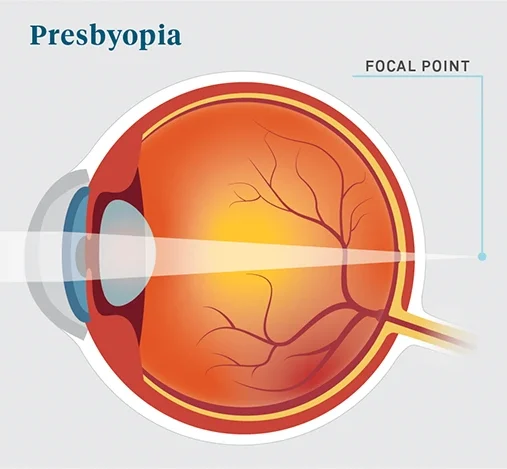
Presbyopia is a natural loss of the eye’s ability to focus on near objects. It happens as the lens inside the eye gradually becomes less flexible, making it harder to adjust focus between far and near.
Unlike myopia (short-sightedness) or hyperopia (farsightedness), presbyopia is related to ageing and not caused by changes in the shape of the eyeball.
What Causes It?
Presbyopia typically begins between ages 40 and 45, and progresses slowly over time. It occurs due to:
- Hardening of the lens inside the eye
- Loss of elasticity in the focusing muscles
- Reduced lens accommodation, making near vision more difficult
It affects everyone, regardless of whether you’ve previously worn glasses or had good distance vision.
Common Symptoms
You may notice signs of presbyopia when performing tasks that require near vision, such as:
- Blurred vision when reading or using your phone
- Needing to hold reading material farther away
- Eye fatigue after prolonged close-up tasks
- Headaches or discomfort with reading or sewing
- Difficulty seeing in dim lighting
Many people first become aware of presbyopia when reading becomes uncomfortable, especially after a long day.
How Is Presbyopia Diagnosed?
Presbyopia can be detected through a standard eye exam. At London Eye & Retina, we assess:
- Visual acuity for both distance and near
- Refraction testing to determine your prescription
- Binocular vision and eye coordination
- Overall eye health, especially in adults over 40
If you already wear glasses or contact lenses for another refractive error (e.g. myopia or astigmatism), we can help adjust your prescription to include near correction as well.
What Are the Correction Options?
Presbyopia cannot be reversed, but it can be managed easily with several vision correction options:
1. Reading Glasses
Simple solution for people who only need help with near vision.
2. Bifocal or Progressive Lenses
Offer a seamless transition between distance and near vision in a single pair of glasses
3. Contact Lenses
Options include multifocal lenses, monovision correction, or modified monovision, depending on your eye dominance and preference.
4. Laser Vision Correction
Procedures such as monovision laser vision correction may be suitable for selected candidates. These aim to improve range of focus but may not eliminate the need for reading glasses entirely.
5. Intraocular Lens (IOL) Options
If you are undergoing cataract surgery, multifocal or extended depth-of-focus IOLs may offer improved near and distance vision without glasses.
We’ll guide you through the pros and cons of each, and help you decide based on your daily routines, screen use, and preferences.
Living with Presbyopia
Presbyopia is a normal part of ageing, but that doesn’t mean you have to accept constant visual discomfort. With the right correction, most people adapt quickly and regain visual comfort for near tasks.
Regular eye check-ups ensure your prescription remains accurate and help detect other age-related eye conditions early, such as cataracts or glaucoma.
See Clearly, At Every Distance
If reading small text has become a daily struggle, it may be time to check for presbyopia. There are many ways to restore comfortable near vision, and we’re here to help you find the one that fits your life.
Book a presbyopia assessment at London Eye & Retina to explore your personalised options.
When Does Presbyopia Start, and Does It Get Worse?
Most people notice presbyopia between their early and mid-40s. It usually progresses gradually over the following years, so reading glasses often need to be strengthened, before levelling off at around the age of 60.
Short-sighted people sometimes find they can read by taking their glasses off, while long-sighted people may notice it earlier. If near vision changes suddenly, or one eye is affected much more than the other, have an eye examination, as cataract or other conditions can also affect focus.
Presbyopia vs Hyperopia (Long-Sightedness)
Both make close work harder, but hyperopia is usually present from birth and is caused by the shape of the eye, while presbyopia is an age-related stiffening of the natural lens that affects almost everyone. Someone can have both, and a full eye examination tells them apart.
Reading Glasses, Contact Lenses and Eye Drops for Presbyopia
- Reading glasses for presbyopia: ready-made readers suit some people, but prescription glasses are better if the two eyes differ or you also have astigmatism.
- Progressive or bifocal lenses: one pair for distance and near.
- Contact lenses: multifocal soft lenses, or monovision (one eye set for distance, the other for near).
- Presbyopia eye drops: drops that temporarily improve near focus by narrowing the pupil have been approved in some countries. Their effect wears off within hours and they are not suitable for everyone, so ask Dr Ng whether they are appropriate for you.
Laser and Lens Options for Presbyopia
If you would like to reduce reliance on reading glasses, options include monovision laser vision correction and lens-based procedures. At London Eye & Retina, presbyopia (monovision) laser treatment is $2,888 for one eye, including GST. These options are explained on our presbyopia treatment page.
If you also have a cataract, cataract surgery with an extended depth-of-focus (EDOF) or multifocal lens may improve near vision at the same time. Dr James Ng will explain the trade-offs, as no option suits everyone.
More questions patients ask
Can presbyopia be prevented? No. Presbyopia cannot be prevented, because it is a normal age-related change in which the eye’s natural lens loses flexibility, and it affects everyone eventually, typically from the 40s. It also continues to progress with age. Reading glasses, monovision laser, lens replacement and eye drops compensate for presbyopia rather than stop it, and presbyopia eye drops only work for several hours.
Can I still get presbyopia after LASIK? Yes, presbyopia can still develop after LASIK. LASIK results are long-lasting, but the eye continues to change with age, and presbyopia affects everyone eventually, even people who have never worn glasses. Some people who had LASIK when younger need reading glasses later in life. A presbyopia option such as monovision may then be considered after a suitability evaluation.
What are the downsides of monovision for presbyopia? With monovision, depth perception and distance sharpness in the near eye are reduced a little, and some people still need glasses for night driving or long periods of reading. It suits people who are comfortable with a small difference between the two eyes, so a trial with contact lenses is often recommended first. Because presbyopia keeps progressing, near vision may need further help in later years.
How much does lens replacement for presbyopia cost in Singapore? Refractive lens exchange (RLE) for presbyopia at London Eye & Retina is quoted after assessment rather than listed at a fixed fee. RLE replaces the ageing natural lens with a multifocal or extended depth-of-focus intraocular lens, similar to cataract surgery. For comparison, presbyopia (monovision) laser treatment is $2,888 for one eye, including 9% GST. Fees may vary, so please confirm with the clinic.
Is presbyopia treatment covered by MediSave? Presbyopia laser correction is elective and generally not MediSave-claimable, like other laser vision correction. Presbyopia (monovision) laser treatment costs $2,888 for one eye and the laser suitability evaluation costs $54.50, including 9% GST. Fees are a guide and may vary with clinical needs, so please confirm your quote with the clinic before treatment.