When Near Vision Feels Like a Strain
Hyperopia, also known as farsightedness, is a common refractive error where distant objects are seen more clearly than nearby ones. While some people with mild hyperopia may not notice it, others may experience eye strain, headaches, or difficulty reading, especially as they get older. Hyperopia is also called hypermetropia, long-sightedness or far-sightedness.
At London Eye & Retina, we understand that good vision isn’t just about what you can see on a chart, it’s about how comfortable and clear your sight feels throughout your daily life.
What Is Hyperopia?
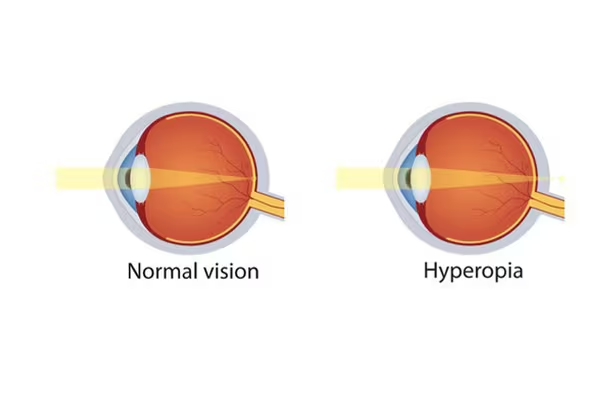
Hyperopia occurs when the eyeball is too short or the cornea is too flat, causing light rays to focus behind the retina instead of directly on it. This makes near vision more challenging.
Children are often born with a degree of hyperopia that may reduce with age. However, for some, it persists into adulthood. In others, it may only become noticeable when the natural lens loses focusing power with age (presbyopia).
What Causes It?
Hyperopia can be caused by:
- Shorter axial length of the eye
- Flatter-than-normal cornea or lens
- Family history of farsightedness
It may be present from birth and often runs in families. In some cases, it is detected only during routine eye screening, especially if the person’s eyes are compensating well.
Symptoms of Hyperopia
Symptoms can vary depending on the degree of hyperopia and your age. Common signs include:
- Difficulty with reading or near tasks
- Blurry vision, especially at close range
- Eye strain or fatigue
- Headaches after prolonged near work
- Squinting to see clearly
- Discomfort or avoidance of reading in children
In children, uncorrected hyperopia may also be associated with lazy eye (amblyopia) or eye misalignment (strabismus) if not managed early.
How Is It Diagnosed?
Hyperopia is diagnosed through a routine eye exam. At London Eye & Retina, we conduct:
- Visual acuity testing for distance and near vision
- Refraction testing to determine the exact prescription
- Cycloplegic refraction in children to relax the focusing muscles for accurate results
- Slit-lamp and fundus examination to assess the overall health of the eye
We also check for any signs of eye strain or binocular vision problems, especially in younger patients.
Management Options
There are several effective ways to manage hyperopia, depending on your age, lifestyle, and vision needs:
- Spectacles – provide clear and comfortable vision for near and distance
- Contact lenses – an alternative to glasses, offering wider fields of view
- Refractive surgery – such as LASIK or TransPRK, for suitable adults with stable prescriptions
- Bifocal or multifocal lenses – for older adults who also need correction for reading
In children, timely correction is important to prevent long-term visual development issues.
Does Hyperopia Worsen Over Time?
Mild hyperopia in children can decrease as the eye grows. However, in adults, focusing on near objects becomes more difficult with age due to presbyopia, a natural stiffening of the lens. This can make pre-existing hyperopia more noticeable, especially after age 40.
Routine eye exams help detect these changes early so that your prescription can be updated as needed.
What Does Far-Sighted Mean?
“Far-sighted” or “long-sighted” means distant objects are usually easier to see than near ones. The eye has to work harder to focus, and younger people can often do this without noticing, which is why mild hyperopia may cause tired eyes or headaches rather than obvious blur.
In higher degrees of hyperopia, or as focusing power falls with age, both near and distance vision can become blurred. It is the opposite of myopia (short-sightedness), where distance vision is blurred and near vision is clearer.
Hyperopia or Presbyopia?
Both make reading harder, but they are different:
| Hyperopia | Presbyopia | |
|---|---|---|
| Cause | Eye too short or cornea too flat | Natural lens becomes less flexible with age |
| When it starts | Usually present from birth | Typically from around the mid-40s |
| Who it affects | Some people | Almost everyone, eventually |
Many people have both: hyperopia that was compensated for when younger often becomes noticeable in the 40s as presbyopia develops.
Glasses, Contact Lenses and Laser for Long-Sightedness
- Glasses with plus (convex) lenses, which may be single-vision, bifocal or progressive depending on age.
- Contact lenses, including multifocal designs for those who also need help with near vision.
- Laser vision correction such as FemtoLASIK or TransPRK may suit some adults with stable, lower degrees of hyperopia. Suitability depends on the prescription and corneal measurements.
- Lens-based options may be discussed for some older adults; see presbyopia treatment.
| Fee | |
|---|---|
| Laser suitability evaluation | $54.50 |
| FemtoLASIK / TransPRK | $2,888 one eye / $4,288 both eyes |
Fees include 9% GST. Laser vision correction is elective and generally not MediSave-claimable.
Hyperopia and Angle-Closure Glaucoma
Long-sighted eyes are smaller and can have a narrower drainage angle, which increases the risk of angle-closure glaucoma. This is one reason a full eye examination, not just a glasses test, is worthwhile.
Seek urgent care for a suddenly painful red eye with blurred vision, haloes around lights, headache or nausea. Call +65 6908 7533 (24-hour emergency eye care available).
Why It’s Worth Checking
Even if your distance vision is clear, untreated hyperopia can lead to chronic eye strain, especially for those doing long hours of screen work or reading. In children, early detection is key to supporting proper vision development and avoiding complications.
More questions patients ask
Can SMILE Pro 2.0 correct long-sightedness? SMILE Pro 2.0 at London Eye & Retina is used to correct short-sightedness (myopia) and astigmatism. If you are long-sighted, FemtoLASIK or TransPRK may suit some adults with stable, lower degrees of hyperopia, from $2,888 for one eye. Your $54.50 suitability evaluation checks your prescription and corneal measurements so Dr James Ng can recommend the procedure that suits your eyes.
Do children with hyperopia need glasses? Not all children with hyperopia need glasses. Many children with mild hyperopia see well because their eyes compensate naturally. Glasses are usually recommended if the hyperopia is moderate to high, the two eyes have different prescriptions, the child has eye strain or headaches, or there are signs of a squint or lazy eye. A cycloplegic refraction, using drops to relax focusing, is the reliable way to measure it.
How often should a long-sighted child have an eye check? Children wearing glasses for hyperopia are usually reviewed every 6 to 12 months, or sooner if there is a squint or lazy eye, to track prescription changes as the eyes grow. Bring your child sooner if you notice an eye turning, new headaches or reluctance to read. An eye specialist will advise the right schedule for your child.
How much is an eye test for long-sightedness in Singapore? Hyperopia is diagnosed through a routine eye examination. At London Eye & Retina Specialist Centre in Novena, a Routine Eye Examination for adults or children (first visit) costs $141.70, and a laser suitability evaluation for those considering laser correction costs $54.50, both including 9% GST. Fees are a guide and may vary with clinical needs, so please confirm with the clinic.
Clearer Vision, Less Strain
If reading feels tiring, or your child avoids near tasks, it might be time for a check-up. With the right prescription and care, hyperopia can be managed comfortably and effectively.
Book an eye examination at London Eye & Retina and let us help you see clearly, up close and at a distance.